An Introduction to Governance- First Approach in the Agentic AI World
First look at AI Governance as concept and the implications on the world of Agentic AI
TLDR
AI Governance is the set of processes, standards, and guardrails grounded in transparency, accountability, fairness, privacy, and security that keep AI and agentic systems safe, ethical, and aligned with human-defined objectives. Operationalizing it isn’t a policy exercise; it requires a real organizational structure (sponsors → steering committee → advisory team → program management → implementation), a defined risk appetite, and grounding in recognized frameworks like the EU AI Act, ISO 42001, and NIST.
Done well, it turns AI risk management into a strategic and competitive advantage rather than a compliance afterthought.
Introduction
In the world of Agentic AI, the speed of delivery often overshadows the way a job gets done. In effect, the performance and efficiency issues are more of a probability problem than an enterprise one.
In such cases, incorporating governance and management in the enterprise agentic world is an exercise in finding the right set of policies and practices to act as guardrails.
The exercise of putting guardrails for efficient and safe execution of AI Agents is termed as AI Governance.
What is AI Governance?
To understand AI Governance, we need to outline a broad definition of AI and its use in the organization. The definition of AI from ISO/IEC 22989 is :
An engineered system that generates outputs such as content, forecasts, recommendations or decisions for a given set of human-defined objectives.
The language is broader and attempts to cover any automated system that may be used to fulfill human-defined objectives.
To that effect, AI can be further classified into :
- General AI
- Narrow AI
- Agentic AI
- Reflex Agents
- Model-based Agents
- Goal / Utility based Agents
- Learning Agents
From the broader definition of AI and its use, AI Governance can be defined as:
AI governance refers to the processes, standards and guardrails that help ensure that AI systems are safe and ethical. AI governance frameworks direct AI research, development and application to help ensure safety, fairness and respect for human rights.
It provides a structured approach to mitigate the potential risks associated with AI systems.
What are principles of AI Governance?
Enterprise Governance aligns with the organization’s strategy and provides a framework of best practices that facilitates decision making and provides a coherent structure for operationalizing the strategy. It is people oriented and provides decision pathway that is predictable and auditable.
In an organization that is predominantly running its processes with agentic workflows, the idea of governance is centered around managing risks of unintended outcomes from the use of AI systems. To ensure this, the AI Governance is built on below principles:
Transparency
Accountability
Fairness
Privacy
Security
The intent to establish these principles as the fulcrum of effective AI Governance is to:
- Minimize the regulatory risk associated with AI systems
- Maximize the trust in the outcomes of AI systems
- Better Understand and monitor the systems and their workflows to align with strategic objectives
How to operationalize AI Governance?
Organizations need a strong foundational AI strategy and policy to implement a effective AI Governance practice. The AI strategy must be aligned with the overall strategy and business goals to sustain the continuously changing landscape of AI.
Organizations need to be capable to build the foundational elements required to operationalize AI Governance. The capability to:
- Establish a AI Governance Center of Excellence
- Establish AI Risk Appetite and Framework
- Enablement of AI Governance Platform
The structure must look like:
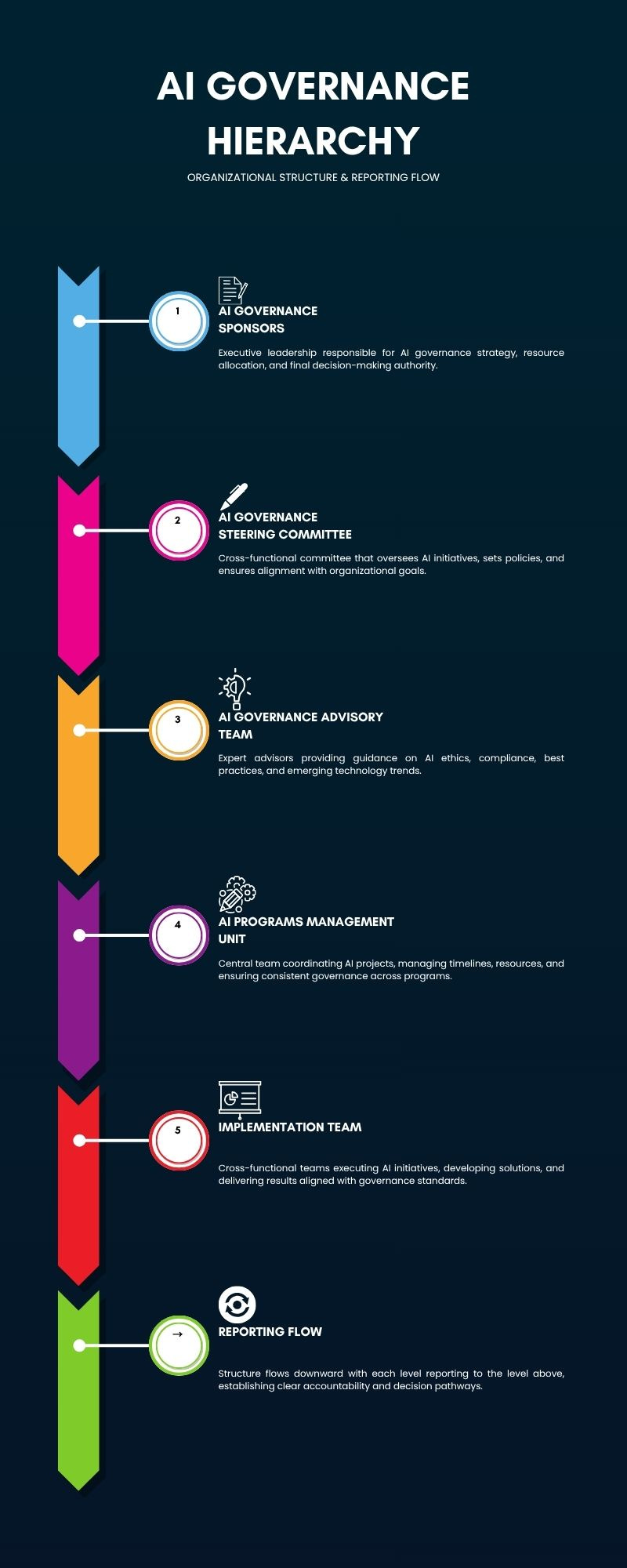
The committee must be grounded in the regulations as defined by EU AI Act, ISO42001 or similar advisory and covered by risk frameworks as defined by NIST or similar frameworks. This ensures the underlying implementation is effective, compliant and monitored across well defined procedures and controls.
What is effective AI Governance?
AI Governance is highly effective when its grounded in the principles.
The principles applicable for any AI Governance framework is defined by Leadership in its objectives and strategy.
The role of leadership is crucial to provide clear directions towards the organizations’ risk appetite, resources and structure. This helps define governance accountability, management responsibility and monitoring metrics that influence the decision making. These are crucial to act as AI Governance enablers.
The AI Governance team responsible for outlining the policies and processes make sure that the AI policy aligns with the organizations’ governance policy in a tangible and measurable way for effective monitoring. This helps in defining and measuring the returns on AI investment.
What are implications of a strong AI Governance?
With the rapid advances in the AI technology, the way organizations are incorporating and using AI systems, it is clear that the risks associated with the AI systems can outweigh the benefits and productivity gains.
The evolving regulatory changes makes it clear that any organization that plans to use AI systems should be able to keep up with the compliance needs that come with it.
AI Governance provides a reliable framework for organizations to develop, deploy, use and decommission the AI systems safely and responsibly for maximum strategic and competitive advantage.
Takeaways
- Governance is a probability problem, not just a policy problem. In agentic AI especially, the goal isn’t to eliminate risk but to manage the likelihood and impact of unintended outcomes through structured guardrails.
- Five principles anchor everything: transparency, accountability, fairness, privacy, and security. Any governance framework that doesn’t map back to these is missing its foundation.
- Operationalizing requires structure, not sentiment. A Center of Excellence, a defined risk framework, and a governance platform are the three foundational capabilities, without them, “governance” stays theoretical.
- Accountability has to flow through a clear chain. Sponsors set direction, the steering committee sets policy, the advisory team grounds it in regulation, and the implementation team executes with monitoring metrics.
- External frameworks aren’t optional references, they’re the grounding.EU AI Act, ISO/IEC 42001, and NIST aren’t just compliance checkboxes; they’re what makes an internal governance program defensible and auditable.
- Leadership defines the risk appetite; the governance team makes it measurable. Strategy without measurable, monitored policy doesn’t translate into practice.
- The cost of skipping this is rising, not falling. As regulatory scrutiny accelerates globally, weak AI governance increasingly means the risks of deploying AI outweigh its productivity gains.
This post was originally published in - https://www.linkedin.com/pulse/introduction-governance-first-approach-agentic-ai-world-kalekar-eitpc/
Let's talk about what needs to change.
An initial conversation with Etherion's senior practitioners. No commitment required.