Nobody asked for a PMO. That's exactly why you need one.
The pain every PMO practitioner recognises - perception, demand, capacity, priority - through the specific terrain of regulated transformation, into governance with real teeth, and finally to the question of whether any of it actually delivered value.

Imagine walking into an organisation where managed chaos had been quietly mistaken for productivity. Not broken. Busy. There is a difference -and most people in that building had stopped looking for it.
Deadlines that were fixed on paper and moving in practice. Workstreams running over capacity and under-resourced, held together by a handful of people who had simply decided not to say how bad it actually was.
I have been in that room. More than once. Different logos on the door. Same temperature inside.
My job, on this particular occasion, was to establish a PMO. Nobody asked for one.
The email arrived without ceremony
Task: establish the PMO. Organisation: mid-transformation. Regulatory pressure: active. Timeline: immediate. Support: to be confirmed.
To be confirmed. That phrase did a lot of work.
What arrived in practice was a calendar that filled with defensive blocks within 48 hours of the announcement. Workstream leads who were suddenly unavailable. Meeting requests that sat unanswered for days. And in the rooms that did happen — a very specific kind of silence. Not hostile. Polite. Which was somehow harder to work with.
I remember sitting in my third one-on-one of the week, watching a very senior Leader listen to me describe what the PMO was there to do. He nodded at everything. Agreed with everything. And at the end he said: "Great, let's stay in touch." We both knew what that meant.
The room had already decided. Before a single process was introduced, before a single report was produced, before a single framework was presented — the verdict was in.
And the verdict was not: we don’t want this.
The verdict was: we have seen this before.
"Tough job. Nobody likes a PMO after decades of delivery policing and perceived interference. Very easy to get it wrong."— David Darwen, Programme Manager and Change Manager
That is not cynicism. That is institutional memory. And you are walking into a room entirely shaped by it.
Before you speak, they already have a story about you
Here is something most PMO writing skips past entirely.
The resistance you encounter is not random. It is not personality-driven or politically motivated. It is the logical output of a set of beliefs about what PMO is, what it does, and who it serves.
Those beliefs are myths. And they are not going to be dislodged by a better slide deck.
There are three of them. They live in different parts of the organisation. They feel completely rational to the people who hold them. And every single one was born from a genuine experience - a PMO that did exactly what the myth describes.
MYTH 01 : WORKSTREAMS & DELIVERY TEAMS
“PMO is here to police how we work.”
Where it comes from: a previous PMO that arrived with a framework and an opinion about everyone’s methodology. That told teams how to run their sprints, which templates were acceptable, what status format was required. Every interaction felt like an audit.
The myth hardened: PMO equals governance tax.
MYTH 02: LEADERSHIP & C-SUITE
“PMO gives me information I already have, in a format I didn’t ask for.”
Where it comes from: a previous PMO that produced RAG reports nobody read, dashboards that were always green until suddenly everything was red, and portfolio reviews that consumed two hours and changed nothing.
The myth hardened: PMO equals expensive administration.
MYTH 03: PMO PRACTITIONERS
“Get the methodology right and the buy-in will follow.”
Where it comes from: training, certification, and a decade of PMO literature that treats governance as a technical problem. If you design the right operating model, adoption will come.
The myth hardened: resistance equals immaturity, not signal.
These three myths are not independent. They feed each other. Leadership doesn’t see the value, so they don’t sponsor the function. Without sponsorship, PMO has no mandate. Without mandate, PMO retreats to process enforcement. Process enforcement confirms the control myth for delivery teams. Delivery teams resist. PMO produces reports about the resistance. Leadership sees the reports and confirms the irrelevance myth.
The cycle is self-sealing. And it starts long before you arrive.
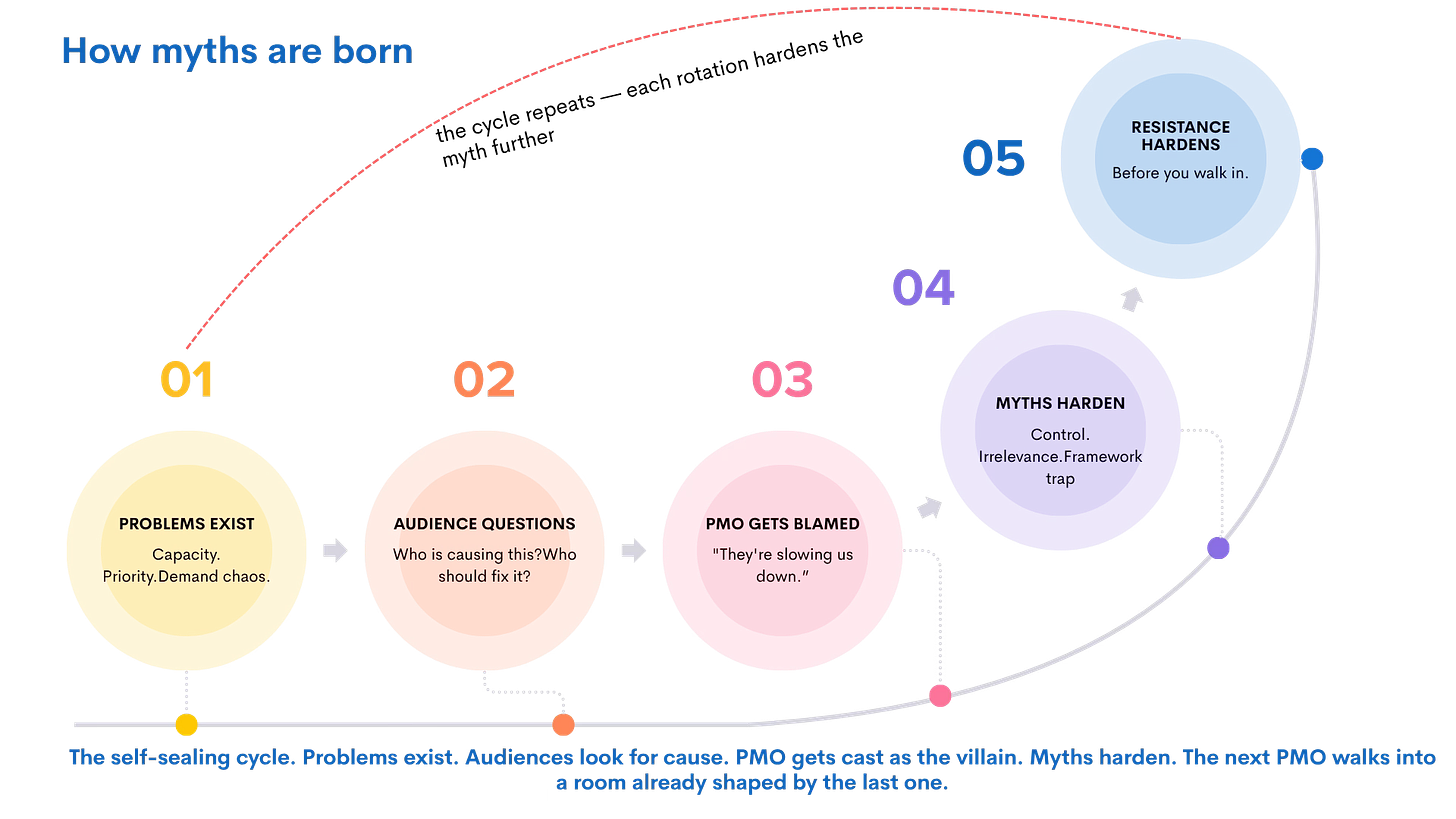
Understanding this changes the approach entirely. You are not just establishing a PMO. You are operating in a room already shaped by a narrative.
Your job in the first months is not governance. It is narrative change.
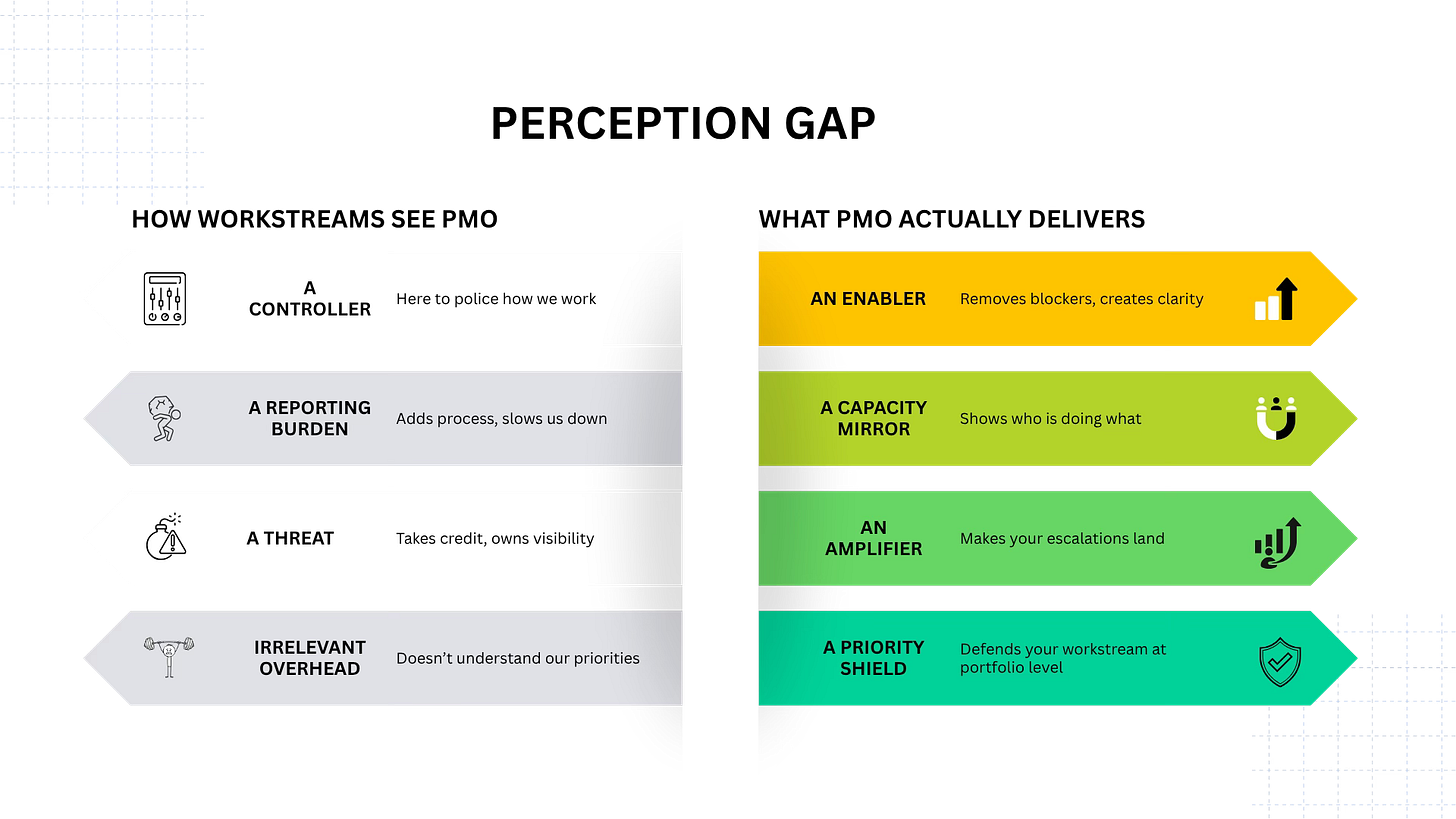
Every room you walk into holds this gap. The myths live on the left. Your job is to close it - not by explaining , but by proving.
What the room is actually telling you
The slide deck stayed in the bag.
Instead: listening tours. One-on-one conversations with every workstream lead, every department head, every person whose resistance was most visible. No agenda circulated. No framework to present. One question at the start of every meeting, and then genuine silence.
What’s making your life hard right now?
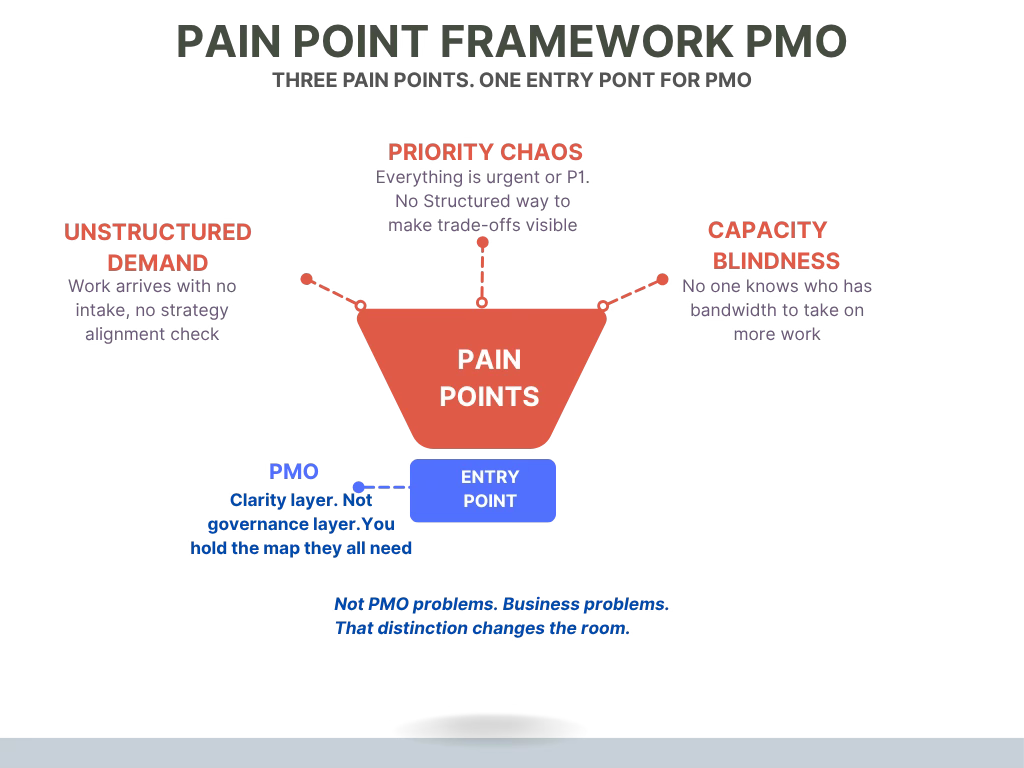
By the fourth conversation I had stopped being surprised. By the eighth I had stopped taking extensive notes. The same three things were appearing in every room, dressed in different language, attached to different examples, but structurally identical. I started drawing the same diagram on every whiteboard. And people kept leaning forward.
Three problems. Every workstream. Every level.I have seen same pattern in almost 3-4 organisations.
- Nobody knows who has capacity for what. Everyone is overcommitted. The overload is invisible because managers protect their teams by keeping it that way. Which means the overload compounds and nobody in leadership can see it.
- Everything is Priority 1. Which means nothing is. The things that get done are not the most strategic - they are the ones backed by whoever shouts loudest. The organisation has no mechanism for making the trade-off visible, so the trade-off gets made by exhaustion.
- Work arrives with no front door. No intake. No strategy alignment check. No capacity sense-check. A senior leader has an idea on Monday and by Friday a team is three weeks into scoping something with no business case, no owner, and no relationship to what the organisation said it was trying to achieve.
These are not PMO problems. They are business problems. The moment you name them that way - the moment you sit across from a workstream lead and reflect their pain back at them in clear language - the conversation changes. You are not selling governance. You are naming something they already know is true.
Chris Kozovski — Director of Enterprise PMO — responded to the teaser with seven words that stopped me mid-draft.
“Projects aren’t complicated. People are.”
I have been in enough rooms now to know exactly what he means.
Thanks for reading Bytes from Etherion! This post is public so feel free to share it.
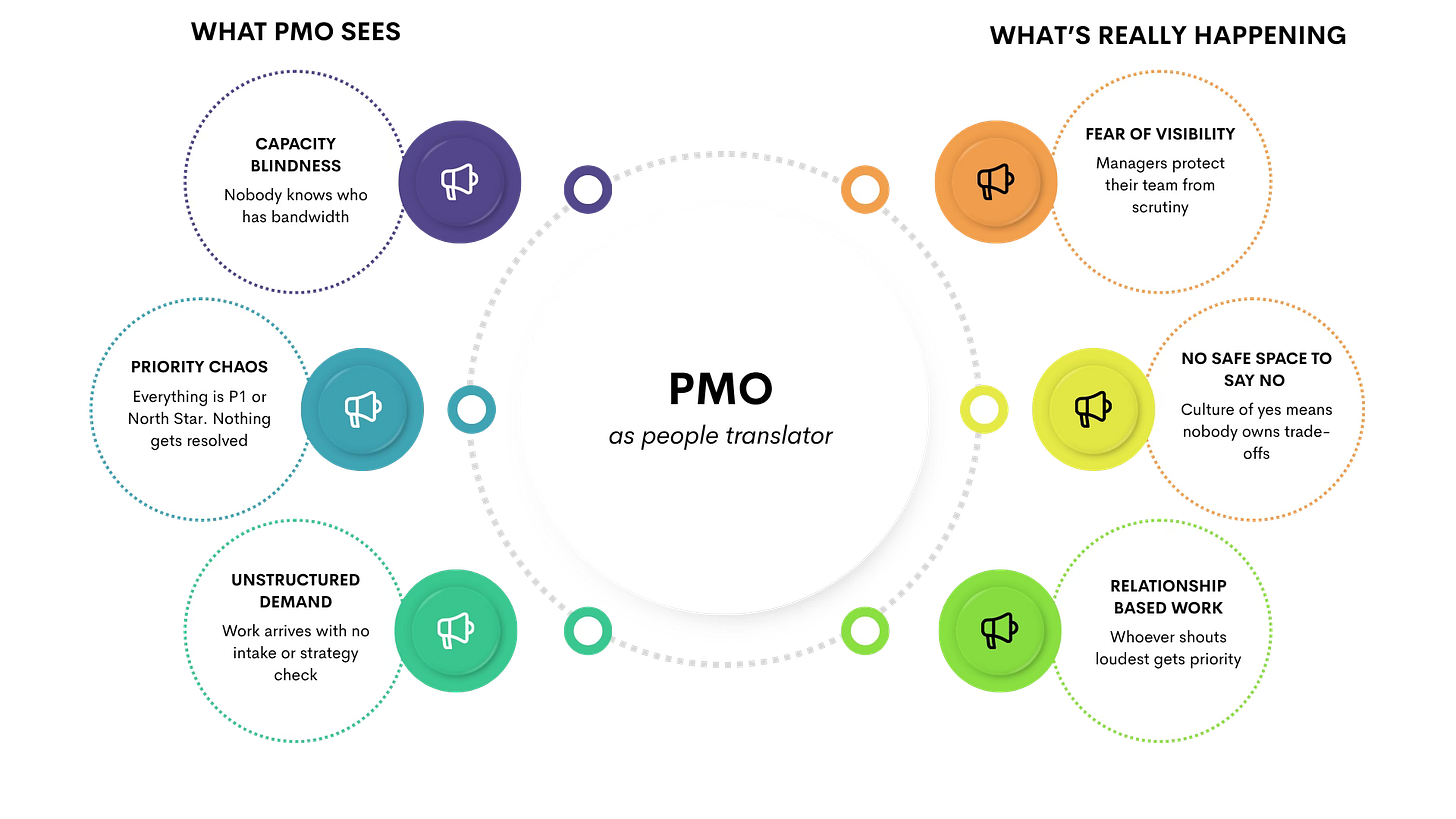
The capacity problem is not a spreadsheet problem. It is a manager who cannot tell their leader the team is drowning because the culture punishes that honesty. The priority chaos is not a planning problem. It is a room full of people who have never been given a safe way to say no - so they say yes to everything and let delivery sort out the consequences. The demand failure is not a process problem. It is work being handed out based on who asked loudest and who likes who - not on what the organisation actually needs to be doing.
Same three pain points. Completely different diagnosis.
And a completely different intervention.
The PMO that understands this operates from a completely different position. It leads with curiosity instead of process. It asks before it mandates. It removes friction before it adds structure. It earns the right to govern before it exercises governance.
That is not a soft approach. That is the only approach that works.
And here is where the story takes a turn I did not see coming.
I had spent the first two months naming the people problem. Listening. Building small amounts of trust in individual rooms. Slowly dismantling Myth 1 - you are here to control us - through nothing more than showing up and being useful without an agenda.
But the pain points alone were not going to move the room at scale. Workstream leads were beginning to trust me. Leadership was still watching. And then something external shifted the entire dynamic in a way no amount of listening tours could have manufactured.
It was a Tuesday morning. I had just come out of a capacity conversation with the operations workstream when I got a message from the Risk Leader. The regulatory affairs team had received a formal inquiry from regulators like APRA. Not a scheduled review. A targeted inquiry. Specific questions. Short timeline. The organisation had five working days to respond with evidence across four workstreams that had never spoken to each other in a structured way.
I remember sitting quitely for about four minutes just thinking: this is it. This is the moment.
Not because I had the answer. Because I was the only person on the floor who had been sitting across from all four workstream leads for the past eight weeks. I was the only one who knew which pieces of the picture existed, where they lived, and how far apart they were from forming a coherent whole. I was not the expert. But I was the map.
That is what the regulatory pressure actually gave me. Not a mandate. Not authority. A reason for the room to care about what I had been quietly building.
Sometimes the burning platform arrives from outside and does the work in five days that six months of listening tours could not. The question is whether you are ready when it does.
The burning platform most people are reading wrong
Here is the thing about operating inside an APRA-regulated transformation that most PMO writing misses entirely.
The regulatory pressure is not the problem. It is the solution.
Every workstream is already carrying a question they cannot fully answer. The regulator will eventually ask it. And when that moment comes in a formal submission, in a review meeting, in a targeted inquiry - the organisation needs to be able to say: here is our delivery confidence, here is our dependency picture, here is the evidence that our commitments are being actioned.
Most workstream leads cannot answer those questions with confidence and the reason is structural, not personal. The information exists - fragmented across spreadsheets, email threads, individual project managers who hold the context in their heads. Nobody has connected it into a picture that the regulator can read.
The reframe is precise and needs to be delivered exactly:
PMO is not a governance layer. PMO is how you prepare for the answers that the regulators will demand as soon as they walk in.
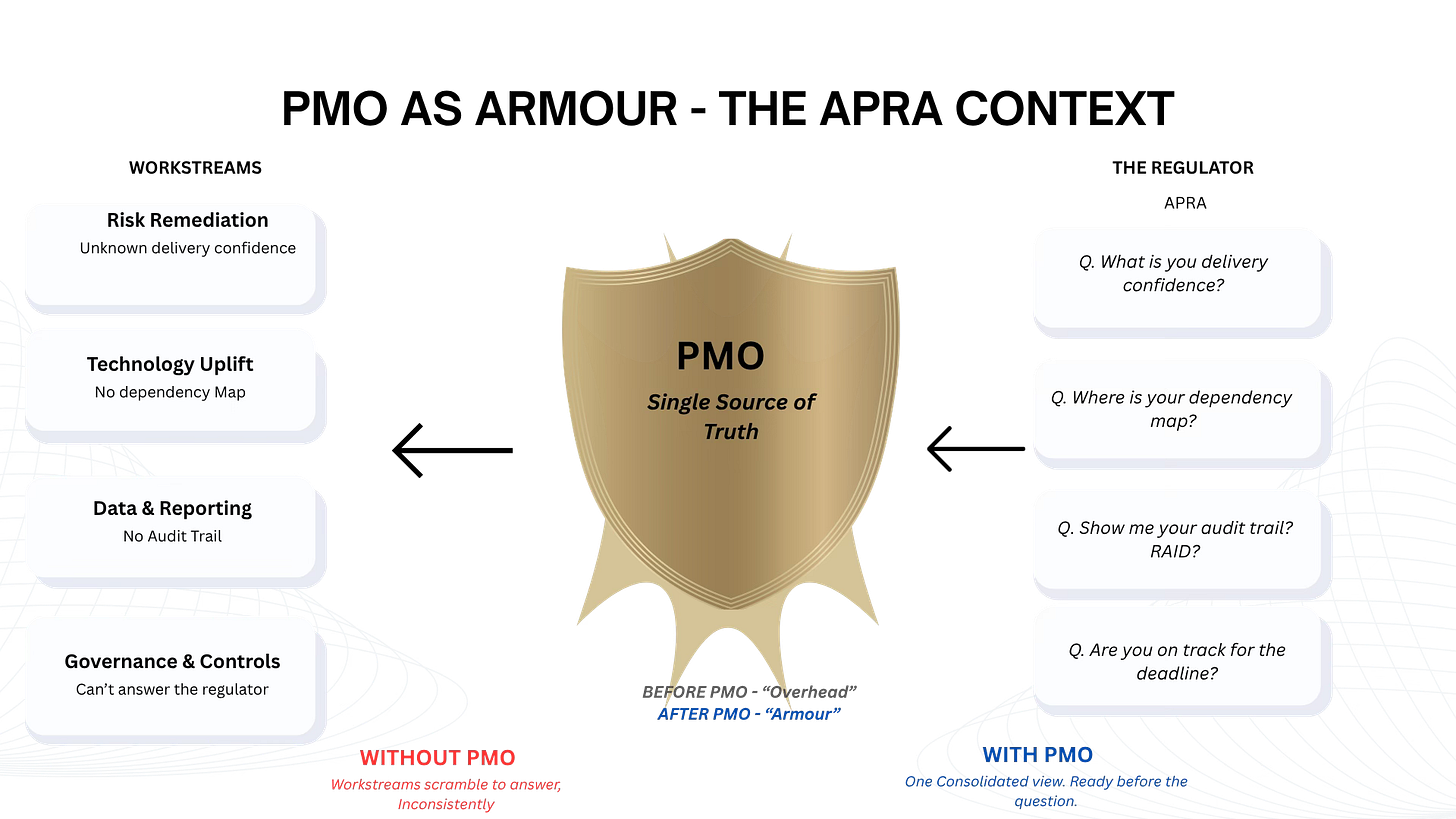
The C-Suite hears the same argument at a higher altitude. Executives in a regulated transformation are carrying three fears: will we make our APRA deadlines, are we spending budget on the right things, and will I be surprised in a board meeting. A PMO that gives them a one-page portfolio view honest, clean, no spin - addresses all three.
Get one C-Suite sponsor early. Make them feel like PMO is their tool. Once one executive publicly backs it, the workstreams pay attention.
Myths don't break at once in a meeting. They disintegrate slowly over a course of time.
You cannot implement a mature PMO into an immature environment and expect it to stick. Maturity is not a process state. It is a trust state. And trust is built through repeated, small acts of usefulness - not through a governance charter.
Four months in, a workstream lead I had been in conflict with for weeks sent me an email. Not about a process. About a dependency she had just discovered that would break her programme if it landed at the wrong moment. She sent it to me. Not to her sponsor, not to the steering committee. To me. Because I had become the person who held the cross-programme picture. That email was worth more than any operating model I could have produced.
The myths do not break through argument. They break through evidence. And the evidence has to come in a specific sequence.
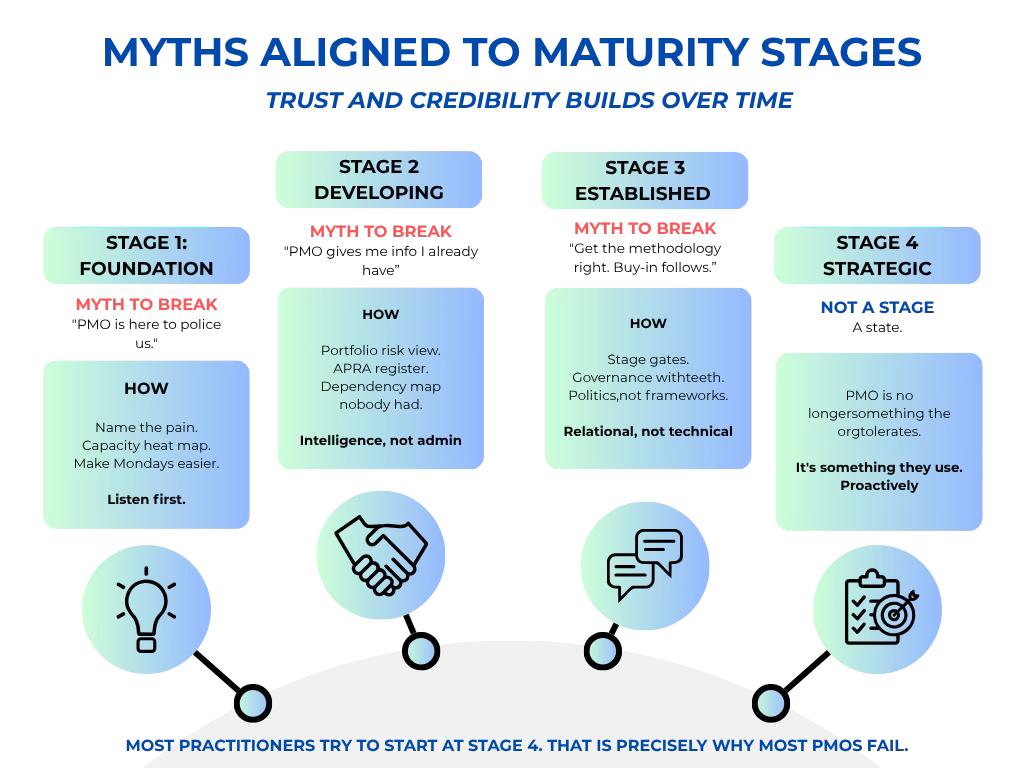
Stage 1 breaks the control myth through action, not assertion. Solve the capacity problem they have been complaining about for months. Name the priority chaos without judging the people in it. Show up and be useful without an agenda.
Stage 2 breaks the irrelevance myth by producing intelligence the C-Suite could not get anywhere else - the portfolio risk picture, the dependency map, the APRA commitment register that finally connects what was promised to what is being delivered. Better reporting was never the answer. A different kind of visibility was.
Stage 3 breaks the framework myth - the one that lives inside PMO itself. The real work is relational, political, and deeply human. The framework is scaffolding. The building is made of trust.
Stage 4 is not a stage. It is a state. The PMO is no longer something the organisation tolerates. It is something the organisation uses. Proactively. Because it makes decisions better, faster, and with less surprise.
As I got familiar with my new environment and challenges, it wasn’t that long before it dawn on me that even though I was able to segregate the problems into stages, I will quickly have to pick out wins from each stage to change the perception of PMO between the downstream work streams and the leadership.
Not a mean feat to achieve, but here we go.
I continued to ask simple questions that did not bother to justify PMO but address the burning issues -
“If a regulator walked in tomorrow and asked you to explain your delivery confidence and your dependency picture - how comfortable would you be answering that?”
The silence that follows is not awkward.
It is the sound of a myth breaking.
In that silence, the person across the table is confronting something they already knew but had not been asked to name. That they cannot answer. That nobody can answer. That the thing they have been treating as overhead is actually the mechanism through which the answer becomes possible.
That silence is your opening. Use it.
Steve Schmitz, who helps PMOs turn strategy into outcomes, framed where this series is heading: “Discover what strategic goals the executive team has prioritised, take the lead to help them achieve those goals, and then provide metrics to prove those goals were met.”That sequence — understand, lead, prove — is the destination. But you cannot lead until you are trusted. You cannot prove value until you have delivered it. And you cannot deliver it until you have dismantled the myths that were in the room before you arrived. That is what the first room is actually about.
After everything in this article — the myths, the pain points, the regulatory platform, the maturity arc — it comes down to this moment.
Work is arriving from everywhere. With no front door. No intake. No one asking whether the organisation has the capacity to say yes — or whether the initiative connects to anything it said it was trying to do this year.
This is the source.
Capacity blindness is a symptom.
Priority chaos is a symptom.
The missing front door is the disease.
Your portfolio doesn’t know what it’s saying yes to.
See you in the next one where we try to bust another one of the myths around PMO.
Let's talk about what needs to change.
An initial conversation with Etherion's senior practitioners. No commitment required.